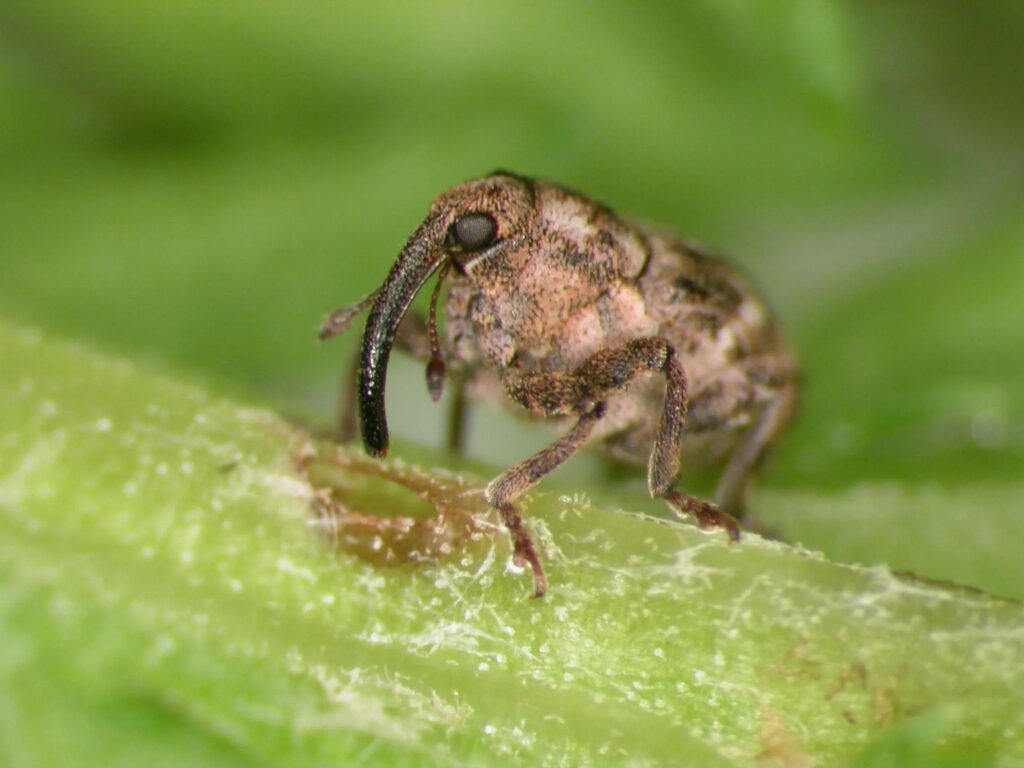
Canada has released the first ever biological control agent to tackle invasive common tansy (Tanacetum vulgare), an invasive plant that negatively impacts the country and wider region’s livestock, rangeland, and native biodiversity. The release of the agent – a stem-mining weevil called Microplontus millefolii – marks a major milestone in efforts to manage this invasive plant across North America, reducing its ecological and economic impacts.
In partnership with the British Columbia Ministry of Forests, Agriculture and Agri-Food Canada (AAFC) conducted the first releases of 1,200 adult weevils in May this year at three sites in British Columbia (BC). AAFC conducted a further release of 400 weevils in Alberta in June, and plans additional releases for sites in BC, Alberta, and Saskatchewan this fall. These releases target areas experiencing significant, negative impacts on agriculture and biodiversity. At the same time, they also allow AAFC scientists to study how different environments influence the success of the weevils’ establishment in their new habitat, and quantify agent impacts on the tansy under different climatic conditions.
“We’re delighted to have conducted the first ever biological control releases for common tansy here in Canada with our partners at the BC Ministry of Forests. This costly and damaging weed has significant impacts on both agriculture and the environment in Canada, and our aim is to manage its spread and help restore native biodiversity. Following our initial releases, we’ll monitor the weevils’ establishment and spread. Over the coming seasons, our hope and expectation is to see evidence of common tansy populations declining, and native plant communities rebounding.” – David Ensing, Research Scientist, Vegetation Ecology, AAFC
Two decades of research paved the way for the release
The approval to release weevils follows two decades of research under an international biological control programme launched in 2006. Common tansy is a plant native to Eurasia. The biological control initiative was created after the weed became an increasingly problematic invasive species across parts of Canada and the United States. Introduced to North America for medicinal purposes, common tansy has spread widely across pastures, rangelands, and natural ecosystems. It has diminished the health of lands used for livestock foraging, as well as displaced native vegetation, and has hindered forest regeneration following logging.
Scientists from the CABI Weed Biological Control Team in Switzerland spent more than a decade evaluating potential natural enemies of common tansy. Researchers reviewed over 160 insect species known to attack the plant in its native range. They conducted extensive host-specificity testing to ensure any biological control agent would not pose a risk to non-target species. International partners, including the Russian Academy of Sciences in St. Petersburg, were involved in specific work with Microplontus.
“After many years of research, this is a significant project milestone – the weevils are now being released into their designated sites in Canada. Biological control offers a nature-based, sustainable solution. The more we can reduce the impacts of invasive plants, the more we can prevent biodiversity loss and protect the natural world upon which we depend.” – Sonja Stutz, Research Scientist, Weed Biological Control, CABI
Why Microplontus millefolii was selected
Between 2010 and 2023, detailed testing of M. millefolii revealed that the weevil is specific to common tansy, making it a strong candidate for release. A guiding principle for biological control is that the control agent, in this case the weevil, cannot damage plants other than the target weed. Several other potential biological control agents were investigated during the program; however, they were found to be insufficiently host-specific for use in North America, except for the moth Gillmeria ochrodactyla, which is currently still under study at CABI.
Microplontus millefolii lays its eggs in the stems of common tansy. Developing larvae feed on the plant internally and weaken its ability to grow and reproduce. Over time, the insect is expected to help reduce the vigour, abundance, and spread of common tansy populations, contributing to the weed’s long-term sustainable management.
The release of M. millefolii represents an important step forward in addressing the ecological and economic impacts of common tansy. Moreover, it highlights the value of long-term international collaboration for developing effective and safe biological control solutions for invasive species.
Biological control is an effective approach to managing invasive plants. The biological control of leafy spurge across North America, for example, led to the long-term, sustained control of this highly invasive weed. In 1997, it was estimated to have invaded over two million hectares with significant economic costs linked to its impact. Its spread has now been reduced to manageable levels, and an analysis for the period 2000-2050 showed that the benefits of using biological control far outweigh the costs of the research and development of the agents. The benefit ranges from 8.6 to 56 times the cost of the work.
Long-term partnerships support biological control in Canada
“The BC Ministry of Forests is excited to welcome this newly approved weevil into our Provincial Biocontrol Program, after many years of supporting the required research by our overseas partner CABI, and our colleagues at AAFC. As the land manager responsible for invasive plant management across roughly 89.1M hectares of provincial public land (94% of the Province), and the lead for operational invasive plant biological control in BC, we continue to prioritize investment into biocontrol as a long term, self-sustaining, landscape level solution, particularly when invasive plants have spread widely throughout the Province.”
“Over 10,000ha of common tansy has been recorded in BC across all climate zones and from 1-1600m of elevation. We look forward to building on the work done by CABI and AAFC to integrate Microplontus millefolii into our integrated pest management approach for managing common tansy in BC, and are grateful for these long-term partnerships that continue to support improved invasive plant management into the future.” – Janine Brooke, Invasive Plant Biocontrol Specialist, BC Ministry of Forests.
Read more:
Tackling common tansy in North America
More information:
Main image : Microplontus millefolii, a tiny weevil with an important role in the biological control of common tansy (Tanacetum vulgare).
Related News & Blogs
Invasive species emerge as a driver of human displacement, new research shows
Human migration is driven by many factors, yet the role of invasive species in displacement remains understudied. A new paper published in Frontiers examines how biological invasions force people to abandon the land on which they live and explores the collective trauma that can follow.
28 July 2026