Invasive alien species are driving human displacement, according to a new research paper published this month in Frontiers. In Kenya, Opuntia stricta has displaced pastoralist communities, while the invasive little fire ant has led to farm abandonment in New Caledonia, the Galápagos Islands and French Polynesia. Water hyacinth has disrupted fishing livelihoods in much of Africa.
The new study argues that biological invasions can erode natural resources vital to human security, forcing communities to abandon their land and livelihoods. Despite these impacts, the link between invasive species and human displacement has received little attention. According to the authors, Dr Jamie K. Reaser and Dr Arne Witt, this is the first article to contextualize the impact of invasive alien species on collective human migration and trauma. Ultimately, they call for stronger international action to address this issue.
A hidden driver of displacement
Cataclysmic events can cause societal collapse, chronic social stress, and trauma, changing community dynamics, sometimes for generations. From natural disasters to pandemics such as COVID-19, displacement can result from many causes. In this case, the paper focuses on invasive alien species as the primary cause. These are animals, plants, or other organisms introduced outside their natural range that become established and negatively affect ecosystems, as well as the people dependent on them. Invasive alien species are among the leading drivers of changes in land use and thus contribute to human displacement.
Dr Arne Witt said, “In the case of invasive alien species, too little attention has been given to the link between their spread and forced migration. Instead, more visible issues such as climate change and natural disasters often overshadow the impacts of invasive alien species on people’s lives. This is despite their close connections. Nevertheless, migration is a growing global concern.”
The authors highlight that at the end of 2024, at least 123.2 million people worldwide were forcibly displaced. This includes refugees crossing international borders and people forced to move within their own country. Research shows that human migration can intensify social disruption and long-term trauma, causing entire communities to be displaced. Therefore, greater international action is needed to better understand the links between biological invasion and displacement.
To illustrate this, the paper examines the impacts of invasive alien plants and animals on rural communities. For example, invasive alien plants can transform ecosystems into highly flammable landscapes, increasing the frequency, intensity, and spread of wildfires. As a result, land may no longer support food production and become even more vulnerable to biological invasions, creating a “fire-feedback loop.” Consequently, increasingly destructive wildfires are driving more people from their homes. They have already reached their highest level since 2020, with nearly 496,000 displacements worldwide.
The human dimension is often ignored
However, invasion biology remains dominated by ecological research, with relatively little attention paid to the human dimension. Research shows that fewer than 5% of reviewed articles on invasive species address social or social-ecological issues. In some analyses, this figure falls below 1%. Likewise, although it makes sense to consider biological invasions within the broader context of sustainable development, an analysis of 56 sustainability topics found that only 0.1% of scientific publications address invasive species.
There is, however, substantial evidence that invasive alien species contribute to drivers of human displacement, including food insecurity. Food shortages force millions of people to migrate every year and can also increase competition, even conflict, over diminishing resources. As a result, displaced communities may lose their agricultural livelihoods indefinitely, leaving them vulnerable to malnutrition and severe poverty.
Many crop pests are invasive and are a major cause of food insecurity worldwide. Annual losses can reach 40% of global food production, even where management measures are in place. Moreover, the impacts of non-native pests have increased in recent years and are expected to worsen. Damage and management costs have roughly doubled every six years since 1970. Invasive species disproportionately affect low- and middle-income countries, which often have limited resources to respond. In addition to crop production, they also threaten fisheries and livestock production.
Impacts on fisheries and farming worldwide
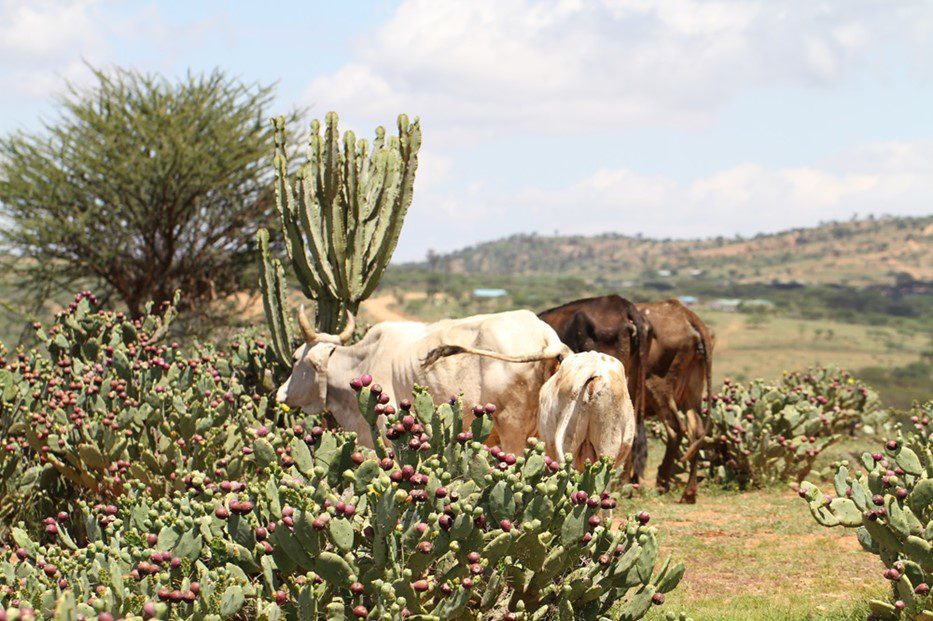
In Kenya, for example, a livestock officer reported that around two-thirds of the Mukurian Group Ranch in Laikipia had been invaded by the cactus Opuntia stricta. This forced around half of its 1,200 farmers to leave. Similarly, a Kenyan study found that almost 80% of respondents knew at least 10 families that had abandoned their homes because of O. stricta invasions.
In New Caledonia, the Galápagos Islands, and French Polynesia, farms have been abandoned due to the invasive little fire ant. Meanwhile, on Lake Victoria in East Africa, local economies have been severely affected by water hyacinth. The floating plant forms dense mats that reduce water quality and hinder fishing. Likewise, in the Wouri River Basin near Douala, Cameroon, a water hyacinth invasion led to a 60% decrease in the number of fishermen actively working and a 76% decline in fish catches.
The need for greater recognition and action
Forced migrations that happen as a result of biological invasions are traumatic experiences that can leave deep individual and collective wounds. We must change the way that we refer to and talk about the impact that invasive alien species have on human lives and livelihoods. Doing so will raise greater awareness of the human dimensions of the issue. The United Nations Convention to Combat Desertification, for example, does not address invasive alien species. This is despite plant and animal invasions being substantial drivers and symptoms of land degradation.
The paper calls for the inclusion of invasive alien species as an indicator of damage to ecosystems and livelihoods within international work programmes. This will help to raise awareness of their potential harm, not only to ecosystems but also to the people whose lives are destroyed when those systems break down due to plant and animal invasions.
Additional information:
Main image: Opuntia stricta poses a risk to cattle pictured here in Laikipia, Kenya (Credit: Sarah Hilliar, CABI).
Full paper reference
Reaser JK and Witt ABR (2026) Invasive alien species are drivers of human displacement: recommendations for a multilateral mitigation framework. Front. Conserv. Sci. 7:1858063. doi: 10.3389/fcosc.2026.1858063
Relevant links
Related News & Blogs
Canada releases the first ever biological control agent to tackle invasive common tansy
18 August 2026