CABI and its partners will launch the “Global Partnership for Pesticide Risk Reduction” tomorrow (19th May 2026), bringing together leading stakeholders from the public and private sector to advance a shared commitment to address pesticide risks worldwide.
While synthetic pesticides have contributed significantly to protecting crop yields, growing evidence shows some ingredients pose risks to human and animal health, the environment, and its biodiversity. Many of these ingredients are also prohibited in high-value export markets, creating additional challenges for exporting countries. The CABI Global Partnership on Pesticide Risk Reduction, which will be launched at an expert webinar, aims to address this issue, strengthening coordinated partnership and mitigating risks through a concerted, international action.
The launch event, hosted by CABI, builds on consultations held with CABI Member Countries and partners globally in 2025. Panel experts will focus on structured interventions needed to safeguard farmers, consumers, landscapes, production, and international trade, while supporting the transition to safer and more sustainable food systems worldwide.
Over the past two decades, a growing evidence base has highlighted risks associated with pesticides. The FAO reports a 71% increase in pesticide use between 2000 and 2023. Climate changes are impacting pest behaviour and populations, increasing the risks of pests spreading into new regions. Invasive species now cost the global economy over USD 423 billion every year, increasing pressure on value chains globally. Plant diseases cost more than USD 220 billion annually.
While pesticides play an important role in pest management, in some low- and middle-income countries, many synthetic products allowed for use are now classed as highly hazardous pesticides, and in one country, comprise of almost 70% of products registered. The toxicity of these ingredients is well documented, with evidence showing that a small number of highly hazardous pesticides can be responsible for 80% of acute and chronic poisonings reported by farmers.
CABI’s Global Partnership on Pesticide Risk Reduction represents a major effort to reduce the impact of pesticides and transition agriculture to more sustainable practices. Reducing pesticide risk necessitates integrated action across the food system, through:
- • Policy – Enabling availability of lower risk plant protection products by improving policies and tackling regulatory barriers.
- • Research – Generating evidence and developing practical solutions, including integrated pest management (IPM) and bioprotection, which support pesticide risk reduction.
- • Production – Equipping value chain actors with the knowledge and capacity to adopt affordable, locally effective lower risk options, and improving the quality and availability of bioprotection products.
Country members and partners of the CABI Global Partnership on Pesticide Risk Reduction endorse this three-pronged approach and are ready to take action. Tomorrow’s webinar marks the launch of this collaboration, bringing together global experts to share insights across sectors, contributing to a collective commitment to reducing pesticide risks for the future.
CABI’s Chief Scientist, Dr Ulrich Kuhlmann, said: “Reducing pesticide risks is an urgent global issue and coordinated action can deliver positive results. No single country or organization can address the issue alone – it requires collaboration across the food value chain. CABI is convening this Global Partnership, bringing its expertise in pesticide risk reduction and sustainable pest management, to offer concrete solutions. If we act together now, we can create safer, sustainable food systems where human health and the environment are protected.”
For more information, contact:
Tamsin Davis, Global Director Communications
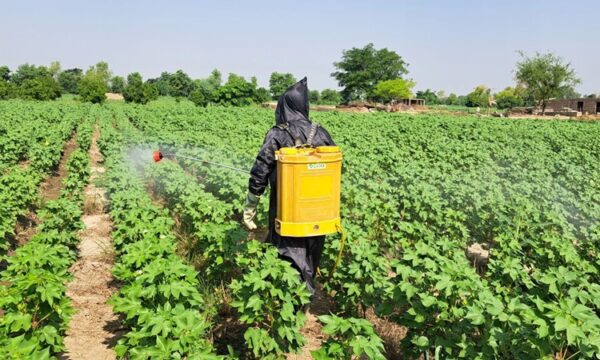
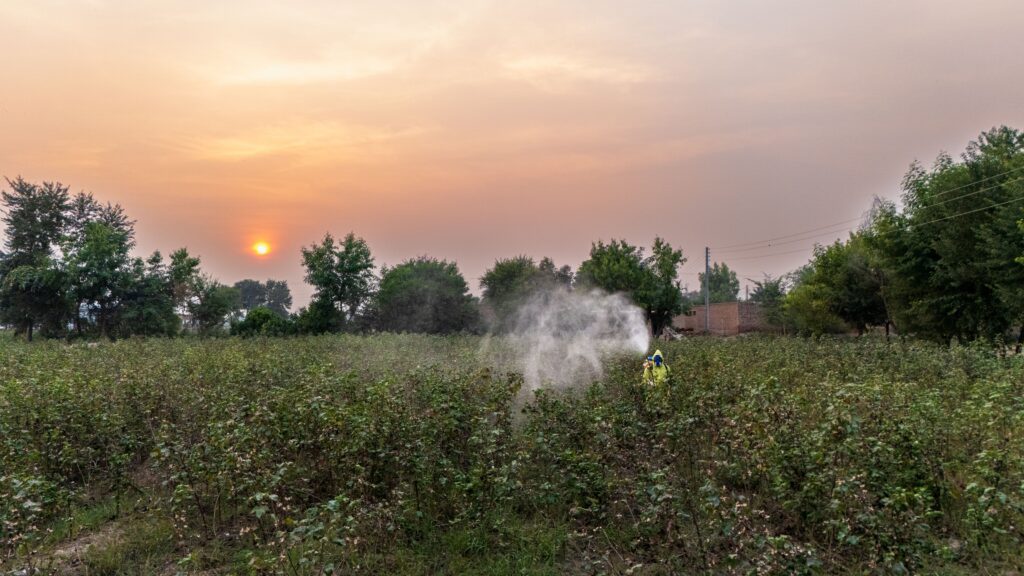
Main image: farmer spraying crops in full personal protective equipment in a field in Punjab, Pakistan. Credit: CABI
About CABI
CABI is an international not-for-profit organization that improves people’s lives by providing information and applying scientific expertise to solve problems in agriculture and the environment.
Through knowledge sharing and science, CABI helps address issues of global concern such as improving global food security and safeguarding the environment. We do this by helping farmers grow more and lose less of what they produce, combating threats to agriculture and the environment from pests and diseases, protecting biodiversity from invasive species, and improving access to agricultural and environmental scientific knowledge. Our 48 Member Countries guide and influence our core areas of work, which include development and research projects, scientific publishing, and microbial services.
We gratefully acknowledge the core financial support from our Member Countries (and lead agencies) including the United Kingdom (Foreign, Commonwealth and Development Office), China (Chinese Ministry of Agriculture and Rural Affairs), Australia (Australian Centre for International Agricultural Research), Canada (Agriculture and Agri-Food Canada), Netherlands (Directorate-General for International Cooperation), and Switzerland (Swiss Agency for Development and Cooperation). Other sources of funding include programme/project funding from development agencies, the fees paid by our Member Countries and profits from our publishing activities which enable CABI to support rural development and scientific research around the world.
Related News & Blogs
CABI-led project aims to promote greater sustainable practices to enhance Pakistan’s agricultural trade
13 November 2024