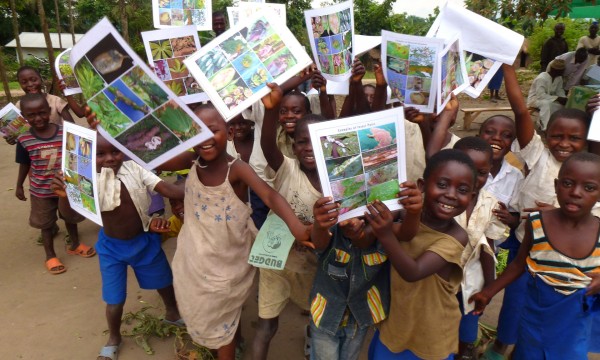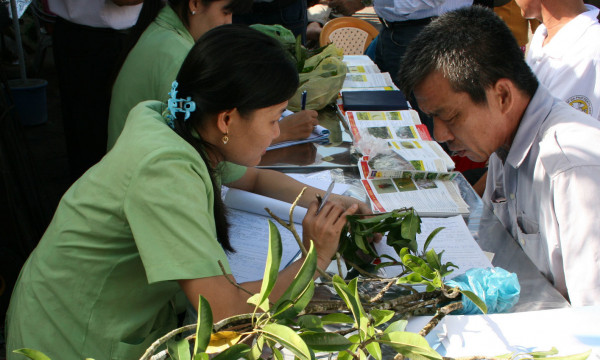
Through the creation and application of digital technologies, CABI brings science-based agricultural knowledge to millions of smallholder farmers helping to increase their yields
The challenge
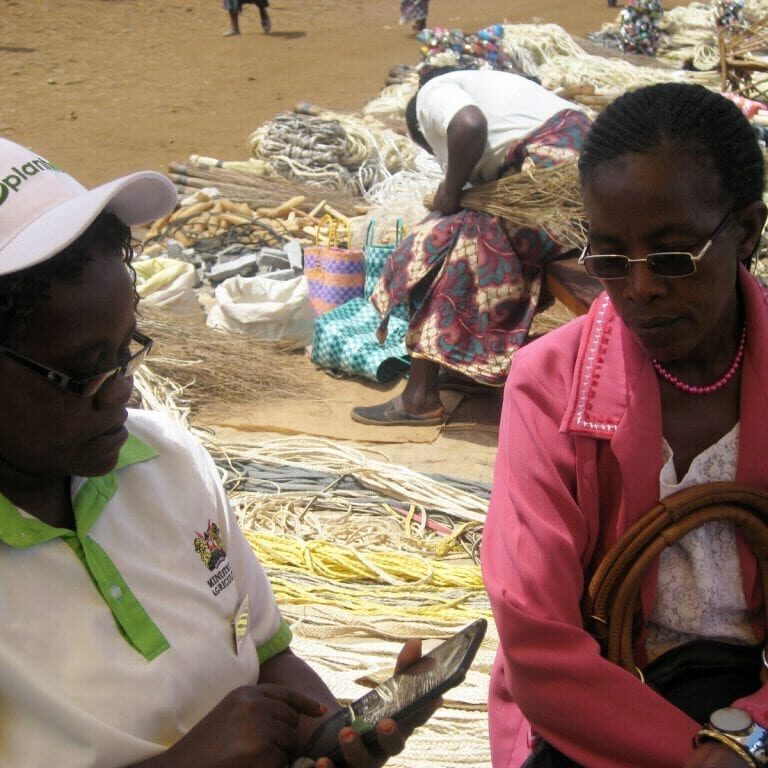
The vast majority of smallholder farmers have little access to agricultural information or public ‘extension’ farming experts. There are just two public extension agents per 10,000 farmers in India and four per 10,000 farmers in Tanzania.
Digital development can help bring practical agricultural knowledge to smallholder farmers and help them grow more healthy, nutritious and profitable crops. Technology also makes the agricultural sector more attractive to young farmers and helps us to target and reach more women farmers.

Providing solutions
Using its expertise in digital development, CABI helps transform smallholder farmers’ livelihoods turning data and science-based knowledge into practical information that addresses their real needs.
Our work in digital development includes the creation of knowledge portals such as the Plantwise Knowledge Bank and the Invasive Species Compendium, as well as apps and mobile phone services that bring agricultural knowledge to smallholder farmers.
Our data-driven development work includes the PRISE pest forecasting system, and the creation of tools such as digital data collection to support project work.
Our digital development expertise in more detail
Digital advisory tools: We develop tools and data-driven approaches. Our core strengths in developing digital advisory tools such as apps, mobile services, web portals and digital learning help stakeholders tackle complex problems by making it easy to understand the science behind challenges and offering best-practice solutions.
Data policy and practice: Our core strengths in data policy and practice help donors address problems related to data management. We offer a range of data policy and practice skills, starting with problem identification and moving through to project design, policy development and mainstreaming of good practices.
Data science and modelling: We develop research-led solutions to support sustainable development and the strengthening of food systems. Our strengths include alerting farmers about impending pest risks, mapping and monitoring the spread of invasive weeds, predicting the potential establishment of insects, and supporting the uptake of biological control.
Lead contact
For more information and enquiries about our expertise in digital development and knowledge management, please get in touch.

Cambria Finegold
Global Director, Digital Development
T: +44 (0)1491 829305 E: c.finegold@cabi.org
Stories of Impact
Read about the variety of work CABI delivers, and the difference we make
Related Projects
Explore our recent projects from around the world
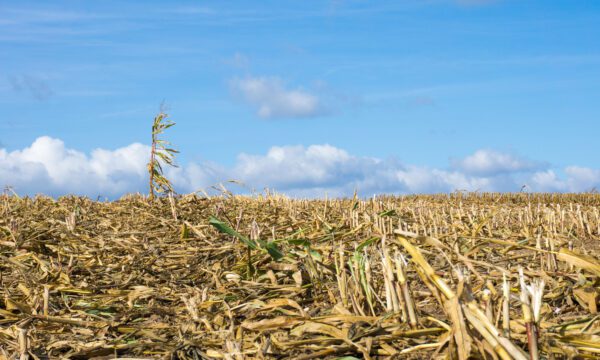
Developing sustainable business models using Earth Observation for climate adaptation
Increasing climate-related risks including extreme heat, drought and the high prevalence of pests and diseases puts agricultural and food systems under constant pressure. While new data and technologies, such as Earth Observation (EO), can help predict and prevent threats, it is not readily available. This project aims to close this gap by delivering a multi-service, multi-user platform that supports collaborative data sharing and application. The system will help to meet the challenges of adaptive agriculture, integrating data sets that address the exposure, hazards and vulnerability of individual commodity supply chains to climate-driven risks. CABI is leading on developing sustainable business and governance models, and a maize use case in Kenya that will help to understand user needs and challenges that EO data and analytics can help address.
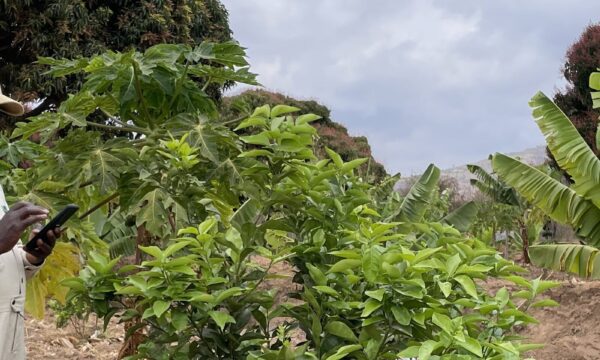
Generative AI for Agriculture Advisory
Generative Artificial Intelligence (GenAI) technology offers enormous potential by addressing information asymmetries and rapidly advancing research. In the agriculture sector, it can localize digital advisory messages and increase the accessibility of such messages to reduce the digital divide compared to traditional, non-AI communication methods. Using natural language processing (NLP) and large language models (LLMs) offers new potential to disseminate complex scientific information more widely, in local dialects and through various formats, transforming accessibility. This project will explore the potential to deliver advisories based on CABI’s highly curated and expert-validated resources to plant doctors and other agriculture advisors via Generative AI chatbot technology, and the data governance and licensing necessary to ensure the quality of such advisories.
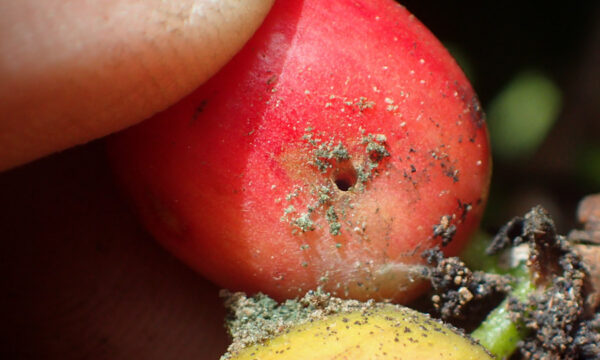
Coffee berry borer modelling for Kenyan coffee production
The coffee berry borer is a major coffee pest worldwide, threatening farmers’ livelihoods and the production of coffee. In Kenya, the pest is a particular problem in low-altitude zones and can cause up to 80% losses. Erratic rainfall and other effects of climate change are making it hard to break the pest lifecycle. In this project, CABI used its tried and tested PRISE model to compile a comprehensive risk assessment of the Kenyan coffee sector and create a model specific to the coffee berry borer in Kenya. With partners, the project aimed to empower farmers and stakeholders within the coffee value chain with actionable advice derived from data and modelling.
Featured Publications
Papers and other publications that we hope you find enlightening
CABI Academy Evaluation 2022
DOI https://dx.doi.org/10.1079/CABICOMM-62-8195
Type Working paper
Published in Working Paper 37
Language English
Year 2025
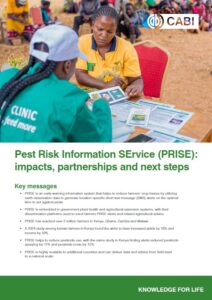
Pest Risk Information SErvice (PRISE): impacts, partnerships and next steps
Type Briefing
Published in CABI Briefing: PRISE
Language English
Year 2025