
Building climate-resilient coffee farming in Indonesia
Indonesia is a major coffee producer, and smallholder farmers play a vital role in the sector. However, climate change, the lasting effects of COVID-19 and limited access to support threaten their livelihoods. Women farmers also face extra barriers to knowledge, skills and opportunities. This project supports climate-resilient coffee farming in Indonesia to address these challenges.
With support from the Asian Development Bank (ADB), CABI is working with partners in Lampung Province. Together, they are strengthening farmer groups and building local training capacity. The project promotes climate-resilient farming practices and sustainable soil management. In addition, it encourages affordable technologies such as biochar and composting to improve soil health. It also supports gender inclusion, financial literacy and farmer-to-farmer learning.
By helping farmers share knowledge and adopt better practices, the project aims to raise farmer incomes. Ultimately, it supports more sustainable, inclusive and climate-resilient coffee production in Indonesia.
Project Overview
So, what’s the problem
Indonesia produces 6% of the world’s coffee, making it the fourth-largest producer globally. The sector earns around US$800 million in foreign exchange. It also supports the livelihoods of millions of smallholder farmers. In fact, smallholders produce more than 95% of Indonesia’s coffee, typically on less than one hectare.
Robusta makes up 72% of production and grows mainly in Lampung. Meanwhile, farmers grow Arabica mainly in Aceh and other parts of Sumatra. Indonesia exports 59% of its coffee, while the rest supplies domestic markets.
Despite its economic importance, the sector faces linked environmental, economic and social challenges. For example, the COVID-19 pandemic disrupted local markets and supply chains. It also reduced trading opportunities, cut incomes and limited farmers’ access to agricultural services. At the same time, climate change brings unpredictable weather, soil degradation and rising pest and disease risks. These pressures affect both production and coffee prices. In addition, competition from crops such as sugar cane and rubber threatens smallholders’ market share and earnings.
Small farms, low volumes and weak coordination also hold farmers back. As a result, they struggle to access markets, share knowledge and strengthen their position in the supply chain. Women play important roles in coffee production in Lampung. However, limited community support, low literacy and restricted access to training hold many of them back. Consequently, they cannot fully develop their farming and financial management skills.
Furthermore, farmers still underuse climate-smart agriculture (CSA) practices. These include integrated pest management (IPM), soil and water conservation, biochar use and improved agronomy. A shortage of trained local facilitators also limits access to practical, locally relevant guidance. Without them, knowledge-sharing rarely continues beyond individual projects.
What is this project doing?
CABI is working with three partners to strengthen smallholder coffee farming in Lampung Province. They are the Indonesia Coffee and Cocoa Research Institute (ICCRI), Louis Dreyfus Company (LDC) and the University of Lampung (Unila). Together, they are developing inclusive farmer groups and improving local training capacity. The project also promotes practical approaches to climate-resilient coffee production.
A key objective is to establish at least 50 coffee farmer groups, each with at least 25% women members. The project also aims to train at least 100 Farmer Group Educators (FGEs). Each group will have at least one woman and one man as an educator. These educators share knowledge on good agricultural practices (GAP), IPM and CSA. In addition, they cover gender equity, financial literacy and farmer group management.
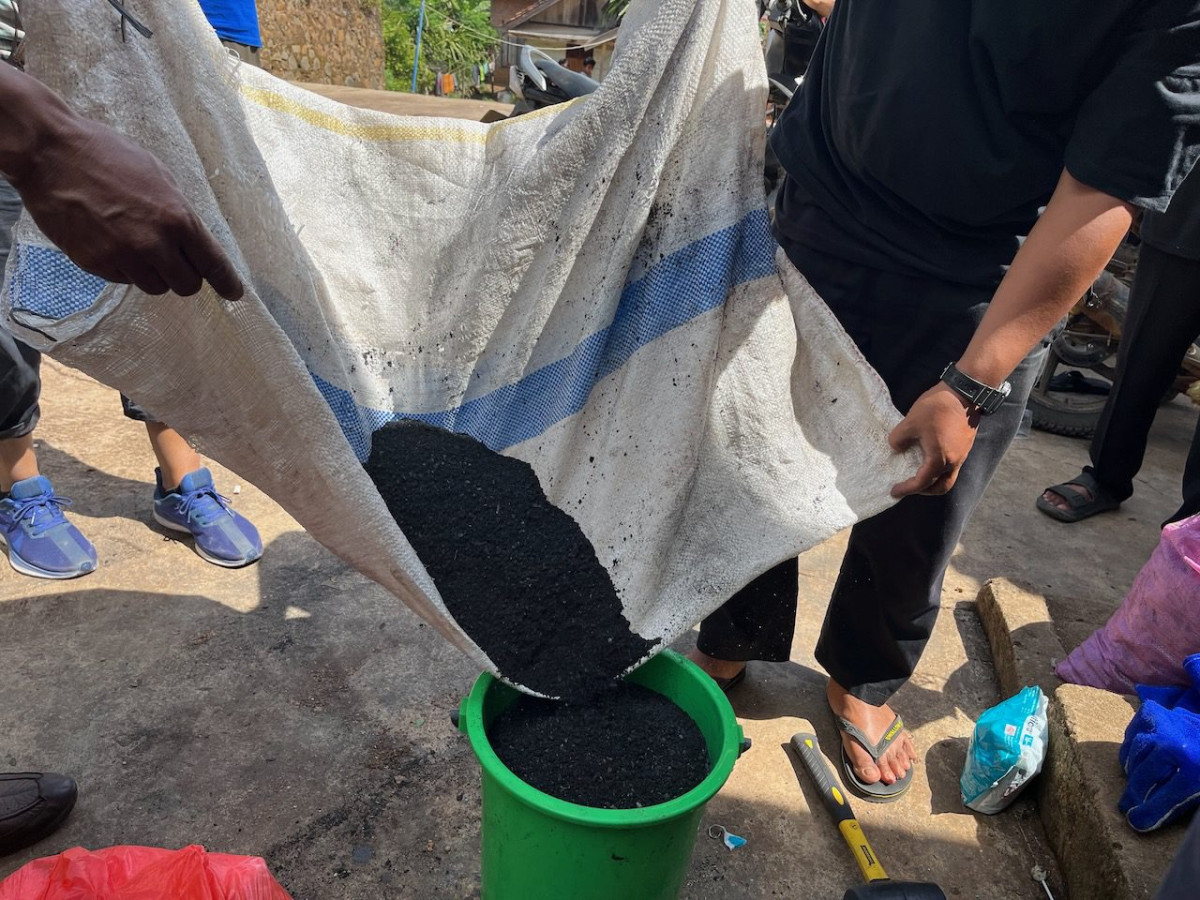
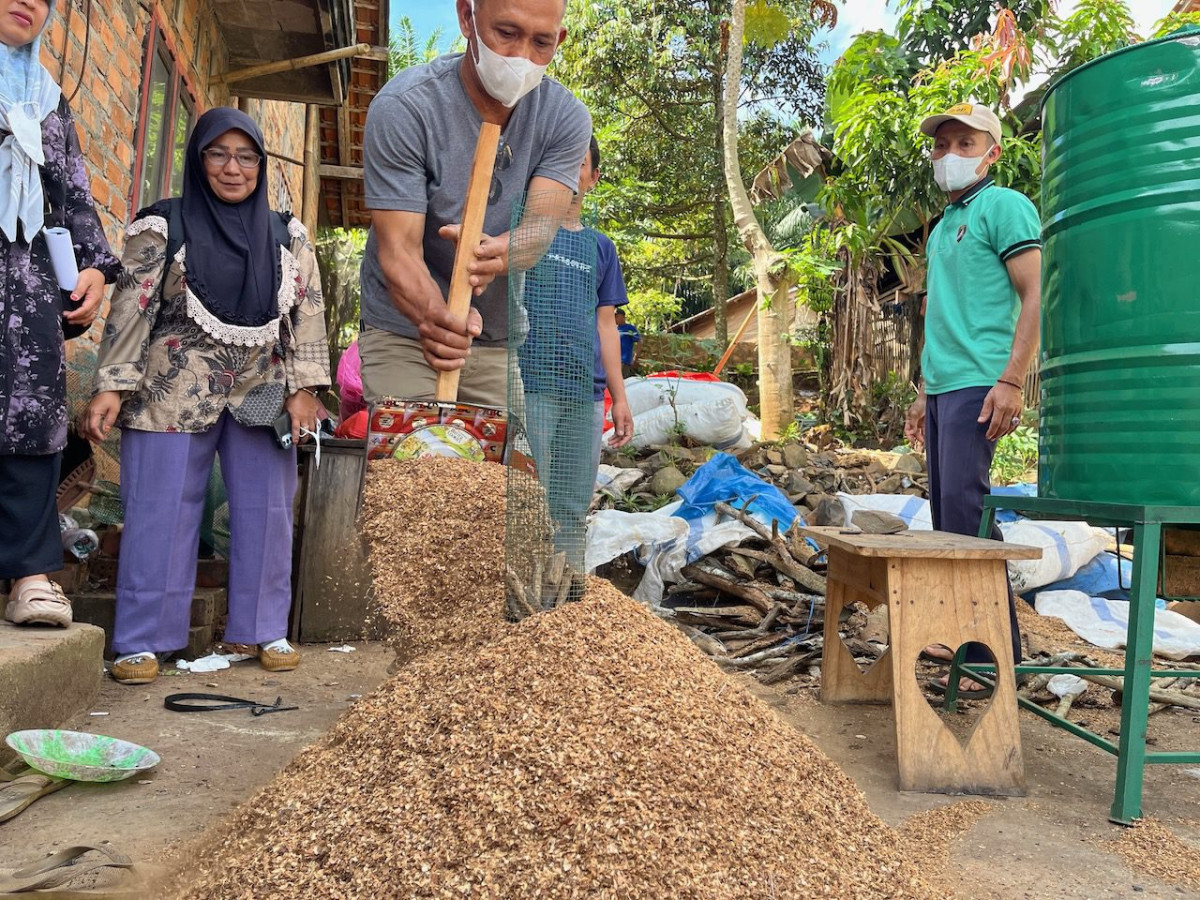
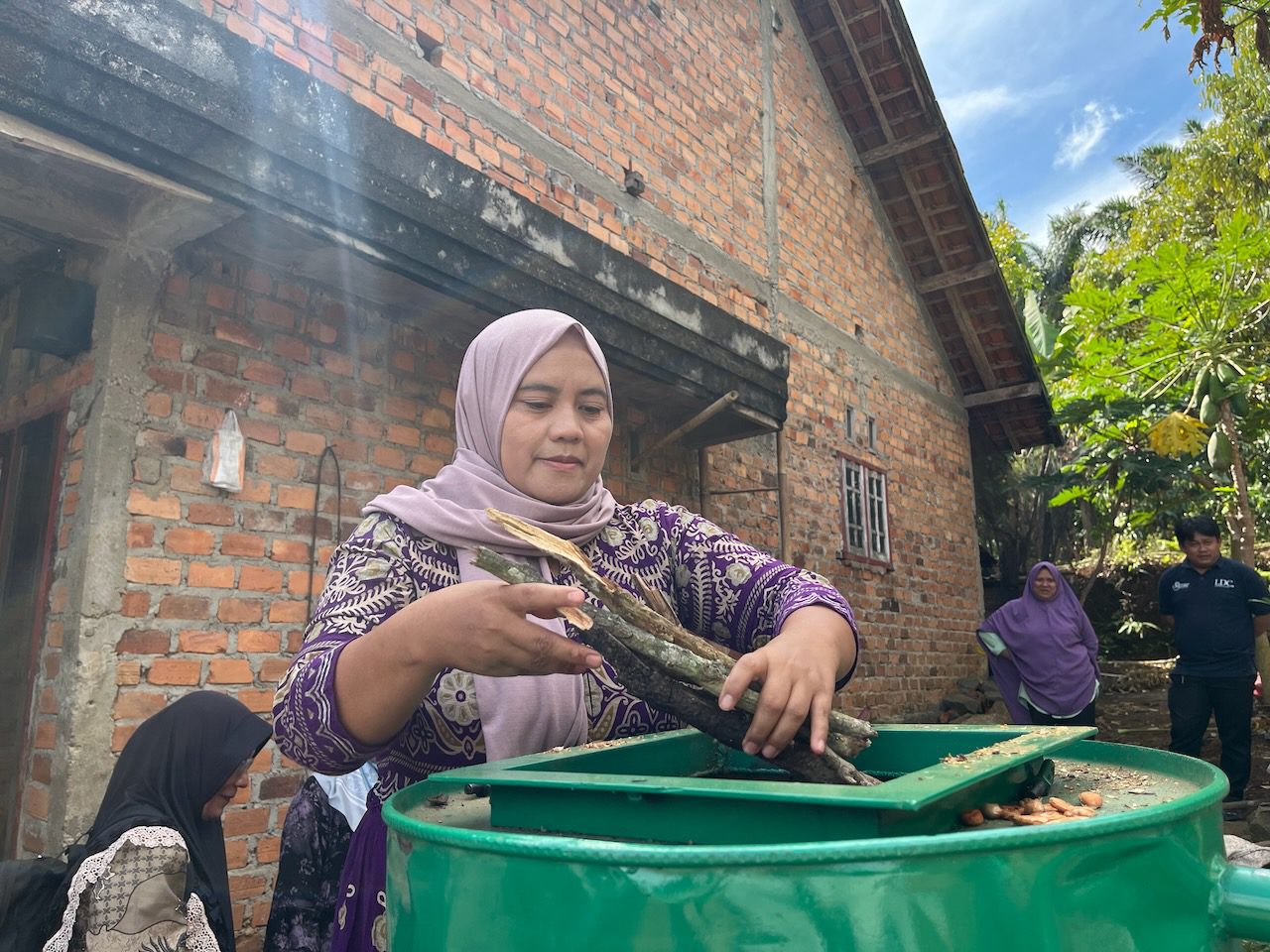
The project also promotes affordable technologies that improve soil health and make use of farm waste. For example, farmers produce biochar using low-cost kilns, including Kon-Tiki and drum-retort designs with condensers. Meanwhile, composting demonstrations turn coffee pulp, cherry husks and woody biomass into soil amendments. Farmers also use other local agricultural and livestock waste.
To extend learning beyond formal training, CABI and its partners have developed practical training modules. They have also produced farmer-friendly technical leaflets and instructional videos. These resources support farmer-to-farmer knowledge exchange in accessible formats. Together, these activities strengthen farmers’ capacity, improve resource management and support inclusive, climate-resilient coffee production.
Results
The project has made significant progress in Lampung Province. So far, CABI and its partners have trained 100 FGEs through three rounds of training. Women made up 47% of participants. Training covered good agricultural practices, integrated pest management, climate-smart agriculture, biochar production and composting. It also covered farmer group management, gender equity and financial literacy.
To support continued learning, the project developed seven farmer-friendly technical leaflets. It also produced two practical training videos on biochar production and composting. Partners printed around 20,000 leaflet copies. They then distributed them to the 100 FGEs and around 1,500 members of 50 farmer groups. As a result, farmers can access practical guidance beyond formal training sessions.
The project set up 20 biochar demonstration units and 30 composting demonstration units across farmer groups. After field testing, the team modified the drum-retort kiln design. This change improved biochar production and liquid smoke recovery. Currently, 19 kilns regularly produce more than 1,000 kg of biochar per month, as well as liquid smoke. Meanwhile, the composting demonstrations give farmers materials, equipment and practical support. This helps them turn local farm waste into compost.
Monitoring and technical support are ongoing. The team is assessing kiln performance, compost production, farmer use and feedback. These findings will help improve the technologies and encourage wider adoption. Overall, the project combines local training capacity, practical demonstrations and accessible resources. In this way, it aims to strengthen farmer groups, improve soil health and support climate-resilient coffee production in Indonesia.
Project Manager

Muhammad Faheem
Integrated Crop Management Advisor
Building A19, MARDI, 43400 Serdang, Selangor, Malaysia

