
Authors’ note: this blog post was written by Dr Mathew Heaton and Professor Nitya Rao. It was first published on the Norwich Institute for Sustainable Development website.
Our global food system is broken, driving human ill-health and environmental degradation, while also increasingly vulnerable to environmental and geopolitical changes. Agricultural research has an impressive record of raising productivity of harvests in the past but the polycrisis today requires a different, transdisciplinary approach to deliver nutritional and livelihood security while restoring ecosystems.
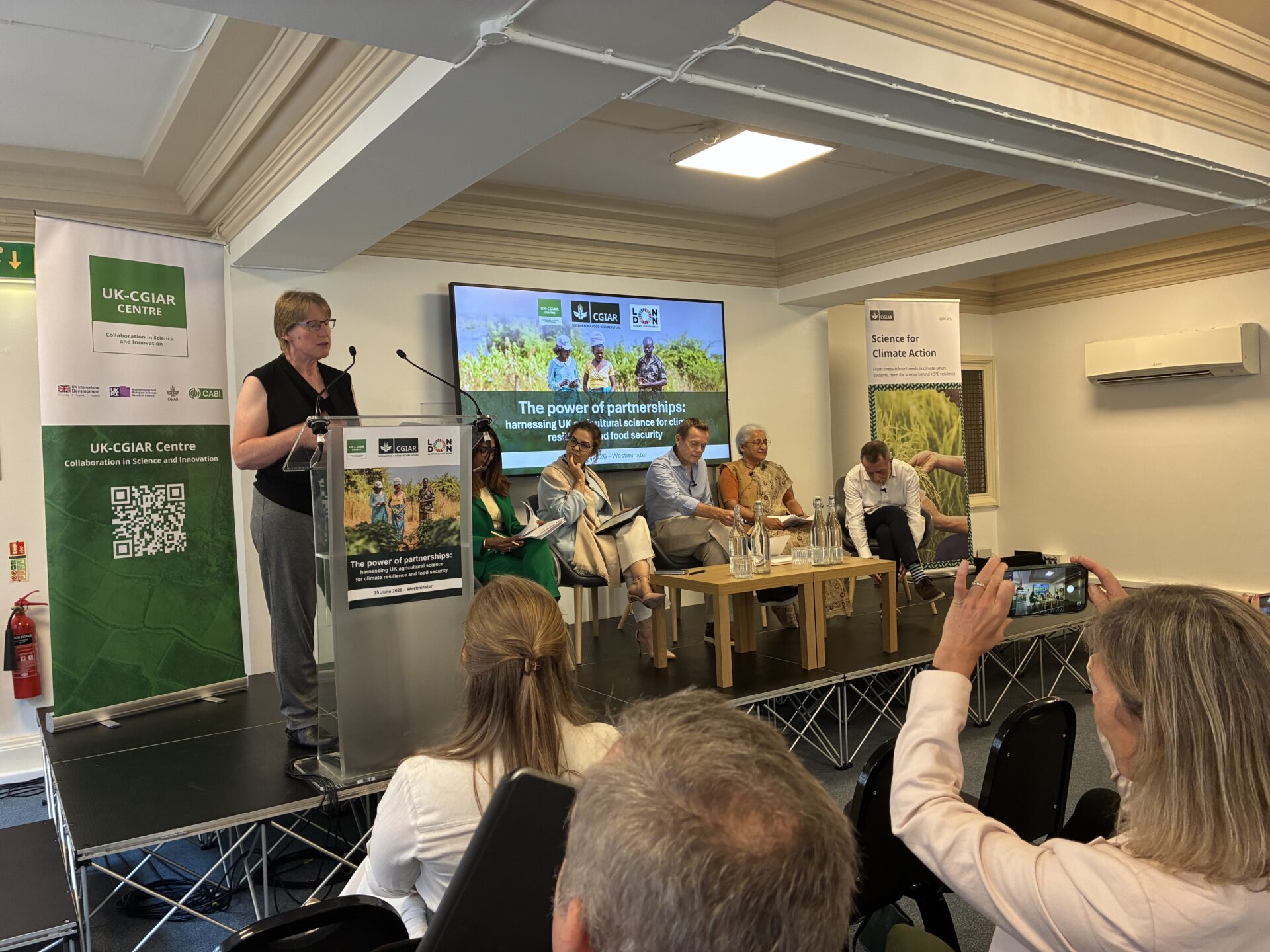
This post focuses on how the UK can build on its strengths in research, based on the principles of diversity, equity and inclusivity to leverage global partnerships for food system transformation.
Recognising UK strengths in agricultural research and global partnerships
The UK has a history of scientific strengths in agriculture through long-established research institutions strategically funded to work with industry for better products and practices.
Rothamsted Research is an example of this provenance, as the longest-running agricultural research institution in the world, dating back to 1843. Combining Rothamsted Research with research centres such as the John Innes Centre, Sainsbury Laboratory, NIAB, Nottingham University, University of Cambridge and University of Oxford, the UK leads in the world for crop science discovery and genomic application.
A good example comes from UK wheat yields that have approximately quadrupled since the early 1900s, largely driven by discovery and incorporation of beneficial traits that result in dramatically more productive and resilient wheat harvests.
A key feature of the impact of UK research has been its approach to international development. This includes commitment to long-term collaboration, continuity in funding ambitions and building trust, inclusivity and more equitable sharing of benefits. It is these extended and honest partnerships that get to the heart of where collaboration is needed and how best to engage.
And this goes beyond the sharing and transfer of knowledge and ideas. The UK should be proud of its support for capacity building, training exchange and investments in global networks. Talk to a room of individuals in the leading development and research institutes outside the UK and it will be filled with stories of their time on UK university courses, PhDs, placements and training workshops – how much they appreciated them, how they instilled essential skills and how it helped their career progression.
Such experiences cascade, as often these same individuals go on to enable wider exchanges with UK institutions and continue to form ongoing research partnerships over their career. At a time of changing geopolitics, the UK must maintain mobility of researchers for the community it unlocks.
The benefits of UK-CGIAR collaboration
Perhaps the clearest examples of how UK agricultural research feeds into global impact is through collaboration with the CGIAR centres, where overlapping interests and complementary expertise raise the chance of impact. UK institutes bring genomics, gene-editing platforms, and disease modelling while CGIAR brings access to target-country germplasm, NARS relationships, and decades of agronomic trial infrastructure, to these partnerships.
An example of this complementary partnership can be found in the John Innes Centre and CIMMYT collaboration on wheat research. Approximately 65 percent of wheat grown in the UK can be traced back to CGIAR breeding material containing important genetic characteristics such as dwarfing that significantly increased yield; and resistance to wheat rusts and other pest and disease threats. The result is wheat varieties that enable UK farmers to produce an additional 793,600 tons of wheat per year, generating at least £193 million in increased profitability annually since 1971.
What is needed for greater future impact are investments in transdisciplinarity, bringing greater integration across the natural and social sciences. Drawing on social, trade and political understandings to improve the design and delivery of innovations, would help address socio-cultural and political economy bottlenecks to real-world impact. Such transdisciplinary partnerships are also the foundation for addressing the basic human rights to food security for all people.
Human rights are fundamental to food security for all
We must address human rights challenges if we are to transform food systems. Structural inequities and power imbalances in food systems are key drivers of hunger. Global food systems are shaped by entrenched economic inequities that privilege industrial agriculture and are characterised by corporate consolidation and export-oriented production. These forces often overwhelm localised, sustainable production and marketing practices.
Agricultural and food workers endure hazardous working conditions, including exposure to pesticides, extreme heat, and dangerous machinery. Their work is often poorly paid, largely unregulated, and disproportionately undertaken by those with few other choices, in particular migrant workers. Women workers additionally confront sexual harassment, and abuse by supervisors.
Embedding the Right to Food into policies requires states to adopt legislative, administrative, and judicial measures that protect, respect, and fulfil this right (Fao 2005 VG on right to food). This entails recognising the needs of different groups of people, ensuring equitable access to resources, inclusive representation in governance and decision-making, and mechanisms for redressal if rights are not implemented.
A rights-based approach thus serves as a moral, normative and practical pathway to achieving food security and sustainability, empowering marginalized communities to regain control over their food systems, and supporting the realisation of human rights within food systems.
Examples of action can be found in: Brazil and Canada securing the rights of indigenous peoples to land under UNDRIP; several countries supporting school meals and; India ensuring public procurement and distribution to ensure no one is left behind.
A growing strength, and one that needs to further strengthen in the future, is the UK’s commitment to diversity in research. The Gender Equality Act in 2014 challenged researchers to consider gender in their research and practice. Scientists and breeders working in labs often asked why this mattered to their work, but the insistence by UKRI to include a gender equality statement in all funding bids has contributed to gradually changing attitudes, thinking through the implications of research on women and men across countries, ethnicities, agro-ecologies.
For instance, our own project found how high iron-rich wheat plants in Egypt and Kenya would vary greatly in their reception, based on local gender roles, financial pressures and extension support. In Egypt, farmers rely on their own harvests for bread production so women farmers are concerned about nutrition, while in Kenya financial pressures mean that households tend to sell all their harvests and use some of this to buy milled flour, so prices and markets remain the drivers of adoption.
Similarly, we find that shifts in agricultural extension models away from on-farm demonstrations are disproportionately excluding women’s participation, which causes a long-term shift of training subject matter to areas more aligned with men’s priorities. Improving gender equality thinking in varietal outputs and agricultural extension could better respond to women’s needs, supporting household livelihoods and nutrition.
Looking ahead
Addressing challenges in food systems today requires bridge building between natural and social sciences, between stakeholders across agricultural science, trade and practice, starting with farm women and men. A promising way forward here can be found in the partnerships formed through the UK-CGIAR Centre project.
Our project on wheat has brought together plant science, bioinformatics, social science and policy to understand how best to bring more nutritious and resilient varieties to farmers. It has helped facilitate discussion on contentious issues such as the regulation of gene editing, helping develop a shared vision and policy framework.
The UK in the past has acted as a facilitator of diverse views under the Chatham House rule and this is becoming increasingly important in a polarised world. We need to create safe spaces for progressive dialogue on difficult topics, based on mutual respect. Ultimately, partnerships to sustain and contribute need to recognize and respect diversity, equity and inclusion. Doing so is essential if we are to achieve nutritious, resilient and sustainable food systems.
Author bios
Mattt Heaton is a research associate for the Norwich Institute for Sustainable Development (NISD).
Nitya Rao is Professor of Gender and Development at the University of East Anglia, Norwich, United Kingdom and Director of the Norwich Institute for Sustainable Development