
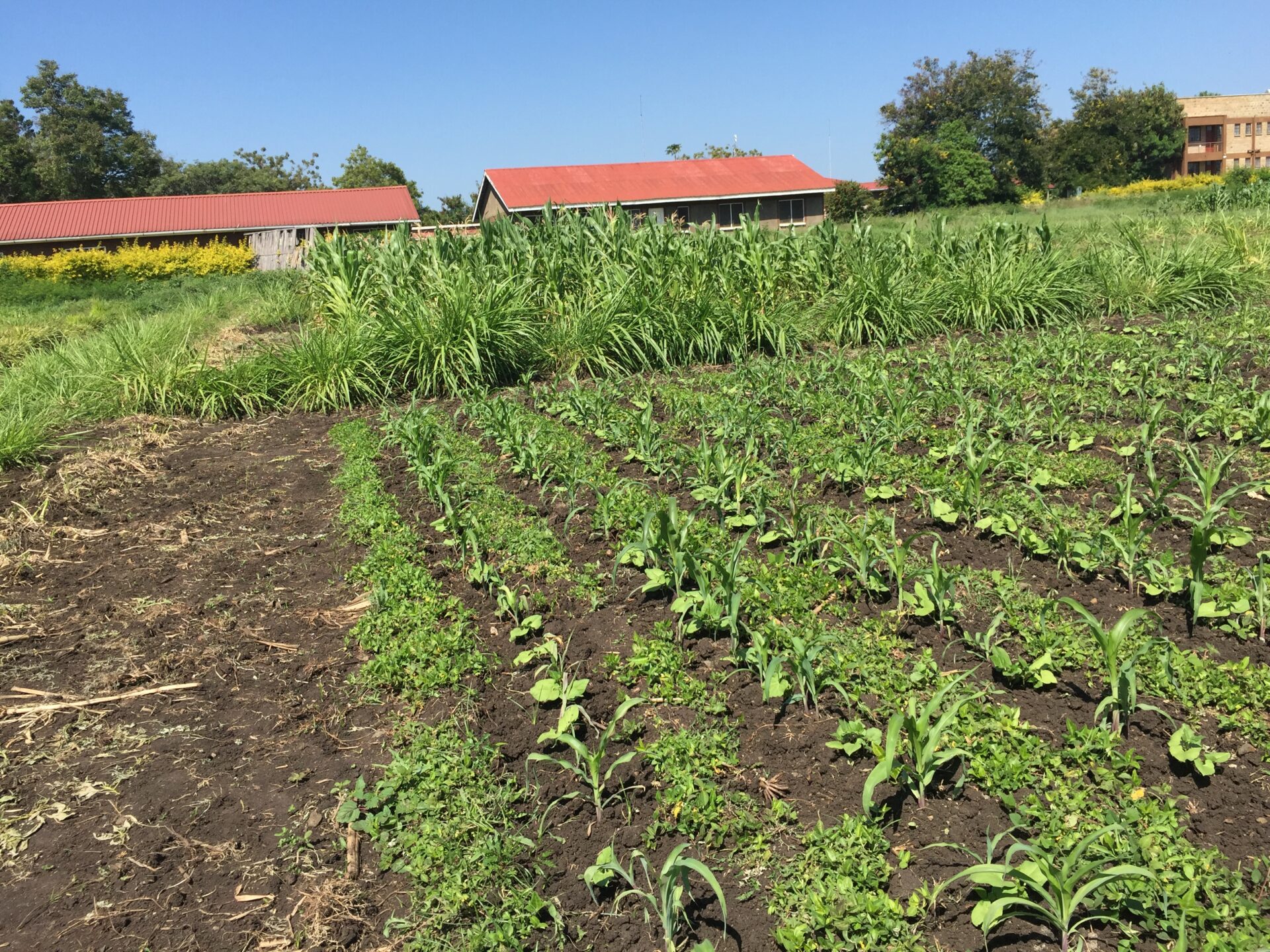
New satellite-based research from iSPARK suggests that intercropping maize with other crops can help maintain healthier vegetation throughout the growing season in western Kenya.
The UK-CGIAR Centre’s iSPARK project (innovation in sustainability, policy, adaptation and resilience in Kenya) has released important new findings on sustainable agricultural practices. The researchers from the University of Leeds used cutting-edge satellite observation techniques to compare maize monocropping with maize-based intercropping systems in western Kenya, a region where maize is an important crop and smallholder farms frequently combine maize with other crops. Published in Frontiers in Agronomy, the findings suggest that intercropped maize generally maintains healthier vegetation and experiences lower levels of vegetation stress than maize grown alone.
“For farmers and agricultural decision-makers facing uncertain futures due to the impacts of climate change, the evidence could prove valuable in supporting the wider evaluation and adoption of intercropping crop systems that are better equipped to withstand environmental stress,” said Professor Andy Challinor, Professor of Climate Impacts at the University of Leeds and the UK lead for the project.
Why crop diversity matters
As climate change makes rainfall increasingly unpredictable and puts pressure on agricultural production, farmers need practical ways to make their crops more resilient. One promising approach is intercropping, which involves deliberately growing two or more crop species together in the same field using a planned spatial arrangement.
Combining crops in this manner can improve the use of available land and may provide complementary benefits. For instance, in this study maize grown in intercrop systems generally showed more favourable vegetation conditions and lower satellite-derived vegetation stress than maize grown alone, across indicators of overall canopy condition, moisture status and greenness. Different crops can also respond differently to environmental pressures, potentially reducing some of the risks associated with relying on one crop alone.
Intercropping is already common among smallholder farmers in many parts of Africa, where maize may be grown alongside beans, potatoes and other crops. However, the benefits of intercropping depend on the crops involved, their growing arrangements and local conditions. Although many farmers already practise and recognise the value of intercropping, supporting its wider-scale adoption requires evidence that can inform agricultural programmes and policy. This is particularly important in regions where small fields and diverse cropping patterns make conventional monitoring difficult, and where satellite remote sensing can provide evidence across larger areas.
Looking at farming systems from space
The researchers compared the two farming systems during the long rain growing seasons of 2021 and 2023, examining vegetation conditions from April to August in each year. They used observations from two European Space Agency satellite programmes: Sentinel-1 and Sentinel-2. Sentinel-1 radar data helped distinguish different cropping systems, while Sentinel-2 optical imagery provided information about vegetation condition.
Using these data, the team developed maps separating maize monocrops from intercropped maize fields. They then assessed vegetation conditions using several indicators derived from satellite measurements.
These indicators examined complementary aspects of plant health:
- Vegetation condition: How healthy or vigorous vegetation appears relative to its historical range.
- Moisture condition: Information about vegetation water content and potential water-related stress.
- Greenness condition: A measure sensitive to changes in chlorophyll and vegetation vigour, which can help reveal potential nutrient or other biological stresses.
The researchers also combined the indicators into an ensemble stress index, providing a broader picture of vegetation condition.
They then developed an additional measure called the Intercrop Advantage Score (IAS). This score brings together the size of the difference between intercropping and monocropping, the uncertainty surrounding that difference, and how consistently the advantage appears throughout the growing season.
Rather than relying on a single satellite image or one measure of plant health, this approach provided a more systematic way to compare cropping systems over time.
What did the researchers discover?
The main finding was consistent across both study years: maize-based intercropping generally showed better vegetation conditions than maize monocropping. What’s more, the satellite observations directly demonstrate how quickly crops recover after a drought or other damaging event.
In 2021, the evidence was strongest for overall vegetation condition. These measures indicated a clear intercrop advantage, while the greenness indicator suggested a more moderate benefit. The moisture indicator produced a mixed result, highlighting that not every aspect of vegetation stress showed the same degree of consistency.
Comparison for crop classification
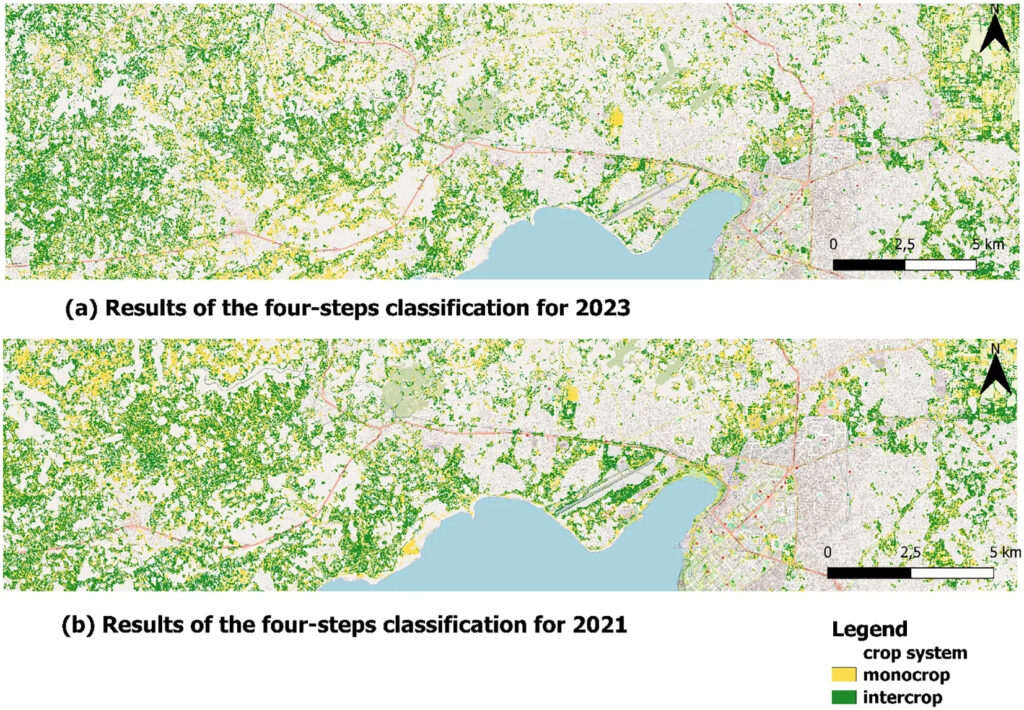
In 2023, the pattern was more pronounced. All four indicators showed a strong advantage for intercropping, with the positive difference persisting across 80–100% of the monthly observations, depending on the indicator. The stronger intercrop advantage observed in 2023 likely reflects differences in seasonal weather, particularly the timing and distribution of rainfall, which influenced vegetation conditions and stress during the growing season.
Comparison for vegetation
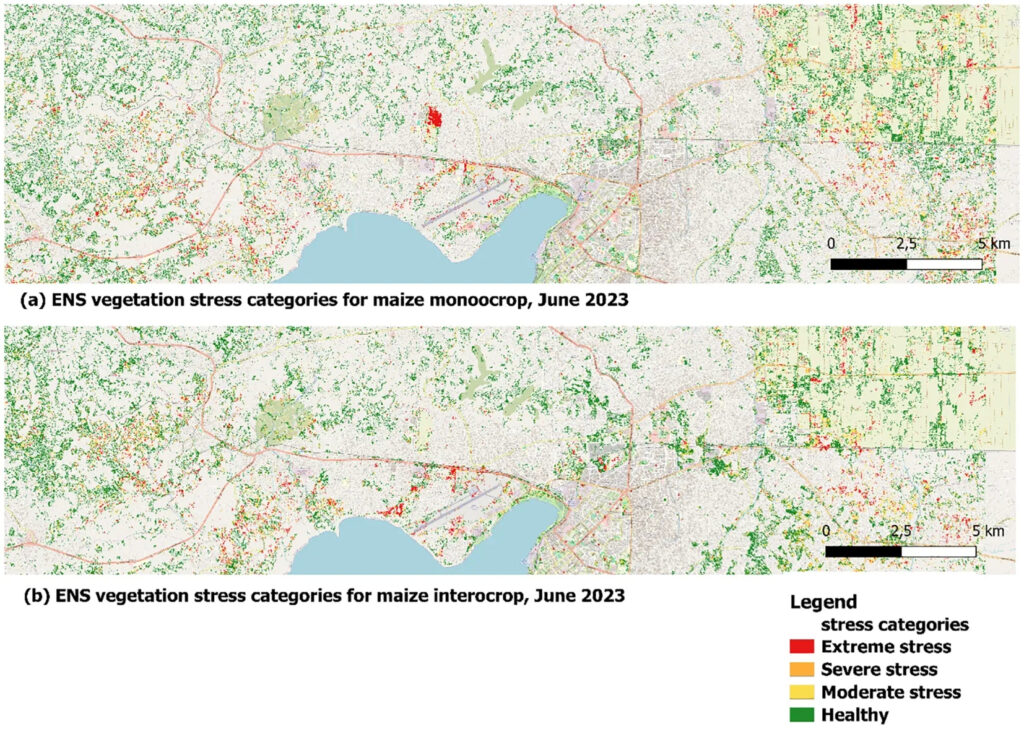
The combined stress index showed an advantage of 0.036 in 2023, compared with 0.015 in 2021. These are differences on the study’s normalised index scale, not percentage increases in crop yield. Together, the findings suggest that maize grown alongside other crops maintained more favourable vegetation conditions across the observed seasons.
What does this mean for farming?
Healthier vegetation during the growing season may indicate that crops are better able to maintain favourable growing conditions under stress. For farmers, this matters because protecting crop growth and health is an important part of managing risks associated with variable weather and other environmental pressures.
Satellite monitoring could offer agricultural researchers and policymakers a way to identify where particular farming practices are associated with better vegetation outcomes. Instead of relying exclusively on measurements from a limited number of experimental plots, researchers could compare cropping systems across much larger areas. As researchers continue to connect satellite observations with real-world farm performance, tools such as the Intercrop Advantage Score could help build a clearer picture of which farming practices work, where they work and under what conditions. The framework can also be applied to other cropping systems, and the team is now extending the approach to push-pull farming, a cropping system designed to reduce pest damage.
However, the study did not measure crop yields, and its findings do not establish that intercropping will always produce more grain or generate higher farm incomes. Although the findings are encouraging, further research is needed before the approach can be used to make definitive recommendations across different farming environments. The study covered two growing seasons in one region of western Kenya. Future research should investigate whether the same patterns occur over longer periods, in different climatic conditions and with different combinations of crops.
Intercropping is not a universal solution to climate-related agricultural challenges, and healthier vegetation does not automatically guarantee higher yields. Nevertheless, these findings strengthen the case for investigating how crop diversity can contribute to more resilient agricultural systems.
Full reference
Chakhar, A., Deva, C., & Challinor, A. J. (2026). High-resolution remote sensing suggests greater vegetation resilience in maize-based intercropping systems than monocropping. Frontiers in Agronomy, 8, 1856833. https://doi.org/10.3389/fagro.2026.1856833
Main image credit: Aneth David.