
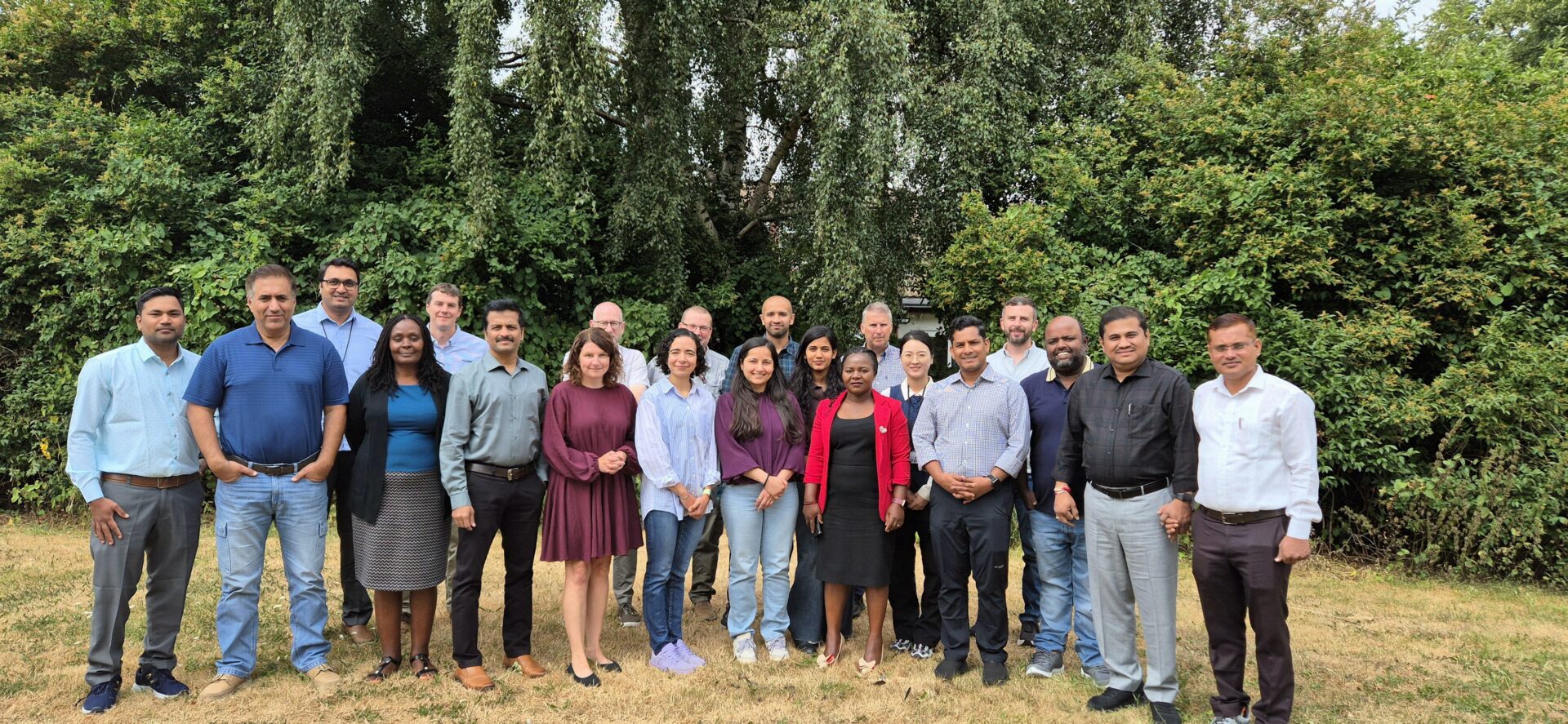
Leading global researchers, funders and experts gathered at the University of Nottingham to share the latest findings and innovations in heat and drought tolerance in pigeon pea to help combat food insecurity.
From 21-23 July 2026, Associate Professor Rahul Bhosale and a team of researchers at the University of Nottingham hosted partners from India, Kenya, Malawi, and the UK for an annual project meeting focused on root-soil interactions in pigeon pea. The meeting was led by the University of Nottingham and part of two UK-CGIAR funded projects.
Pigeon pea is an important grain legume crop that is widely grown and consumed across South Asia and parts of Africa. It plays a key role in supporting food security and farmer livelihoods, but its low tolerance to heat presents sustainability and yield challenges as global temperatures continue to rise.
Researchers from the University of Nottingham, working alongside scientists from the University of Warwick as part of the UK research team, are investigating how high temperature affects root growth in soil using controlled heat treatments and advanced scanning technology at the Hounsfield Facility on the Sutton Bonington campus. These findings are also being shared with partners at The International Crops Research Institute for the Semi-Arid Tropics (ICRISAT) and The International Maize and Wheat Improvement Centre (CIMMYIT) to support the development of practical solutions to maximise project impact.
Connecting researchers, funders and communities in food systems innovation
The meeting was opened by Professor Sacha Mooney, Head of the School of Biosciences during an opening session held at the University’s Jubilee Campus in Nottingham. In his remarks, Professor Mooney highlighted the University of Nottingham’s unique capability to lead collaborative research and innovation in soil science and root growth while utilising its state-of-the-art soil and crop facilities. He noted that such facilities accelerate research and innovation, both within academia and for industry, particularly in research areas where the University of Nottingham has a strong track record in in attracting funding and building research partnerships.
The meeting was attended by representatives from the University of Nottingham, University of Warwick, ICRISAT, University of Agricultural Sciences, Dharwad and Raichur, India, KALRO- Kenya, DARS- Malawi, CIMMYT and the UK-CGIAR Centre.
Presentations were delivered by Dr Prakash Gangashetty, Global Pigeonpea Breeding Lead at ICRISAT, who highlighted the importance of pigeon pea as a climate-resilient crop and outlined advances in the breeding programmes and research application across India. Dr Sivashakthi K, Field Physiologist, shared progress from ICRISAT and NARES partners on multi-location field trials across India and Africa, evaluating heat tolerance in a pigeon pea diversity panel conducted under staggered planting.
Dr Raman Babu, Programme Director for Accelerated Crop Improvement at ICRISAT, said: “This is a critical moment for research and innovation. Projects like these help us deliver healthy and nutritious food through social programmes and initiatives, ensuring that innovations can be transferred to farmers and communities and ultimately brought to market.”
Driving progress and impact worldwide
The project is already achieving significant success. Throughout the meeting, partners gave updates on the progress across the programme, including a notable milestone: the identification of heat tolerant pigeon pea genotypes with temperature adaptive root traits.
Dr Prakash Gangsashetty also highlighted further progress being made to improve breeding efforts to meet global demand and reduce production times: “We have achieved a lot together with partners in India, Kenya, and Malawi to discover the genes associated with root length, heat stress tolerance and drought tolerance in pigeon pea to combat the major production challenges in Asia and Africa,”.
Prof. Gifford (University of Warwick) noted that “It is extremely significant that the team have not only identified heat-resilient pigeon pea varieties but also heat-resilient rhizobia which enables efficient nitrogen fixation. In combination this will help boost crop growth and enable us to develop a more mechanistic understanding of heat resilience in this sustainable partnership.”
Dr Rahul Bhosale, University of Nottingham project lead, shared progress being made in the UK, supported by two PhD students Aneesh Lale and Ashwini Kaylan. While most research to date on pigeon pea has focused on plant physiology under individual stressors, less is understood about how heat and drought interact to influence whole plant responses, both above and below ground, when they occur simultaneously.
Dr Bhosale’s team is addressing this knowledge gap through five work packages, including one focusing on the role of temperature-adaptive root traits within the root-soil ecosystem with the aim of improving soil health and nutrient retention. Their early findings show that combined heat and drought stress alters shoot architecture, with the changing environment directly affecting crop growth and productivity. Root responses however differed under combined stress, where roots and water movement were pulling in opposite directions. This offers new insight into how pigeon pea adapts below ground under environmental pressure.
Dr Bhosale said: “Understanding how pigeon pea responds to both individual and combined heat and drought stress is becoming increasingly important as climate change intensifies across many agricultural regions.” He continued, “By bringing together expertise from the UK, India, Kenya, and Malawi, we are generating data to help us identify key traits and associated genes that can be used to develop more resilient pigeon pea varieties and ultimately support farming communities.”
Looking forward
The annual meeting also involved future planning discussions and site visits which showcased the University of Nottingham’s excellent plant science research facilities.
Charles Rowley, Project Manager at UK-CGIAR Centre, commended the team for the collaborative research delivered so far: “I’m honoured to be invited here and to support the pigeon pea project, under the UK-CGIAR’s focus area of Crop Breeding for Climate Resilience. Given the success that the project is already achieving and seeing them do it in a highly collaborative way is refreshing.”
The team will now focus on integrating findings from field trials, controlled environment experiments and root-soil interaction studies to accelerate the identification of candidate traits and genes for breeding climate resilient pigeon pea varieties.
Future work will focus on validating these insights across different environments in India, Kenya and Malawi, while strengthening links between fundamental research and breeding programmes.
“I’d like to thank all our project partners for their contributions and commitment to this work,” said Dr. Rahul Bhosale. “This research has been made possible by the support and dedication of support of researchers, students, technical staff and collaborators across the UK, India, Kenya and Malawi as well as the continued support of UK-CGIAR, ICRISAT and CIMMYT, whose partnership has been essential to delivering impactful research outcomes.”