
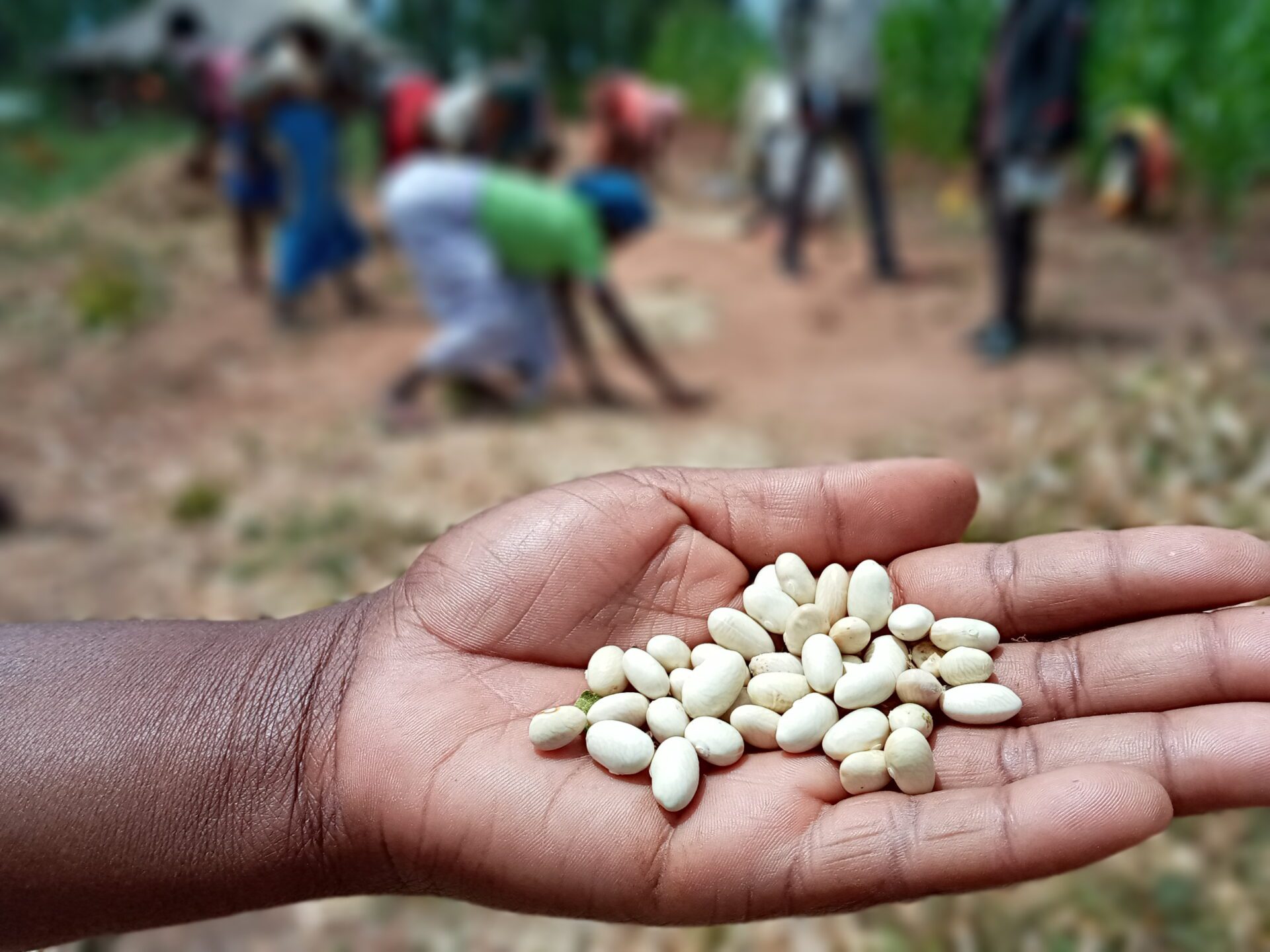
The UK Legume Research Community gathering represented an opportunity for scientists working on UK-CGIAR projects to showcase their research on legumes.
In May, researchers on the UK-CGIAR Centre projects as well as a representative from the Centre’s board presented at the UK Legume Research Community 2026 (UKLRC 2026) event, hosted by the James Hutton Institute, in Dundee, Scotland. Despite their widespread adoption in many parts of the globe, legumes remain underutilised across the UK. The UKLRC2026 gathering aimed to support collaboration and knowledge exchange amongst scientists working on these remarkable crops.
Last year, the UK-CGIAR Centre commissioned three new projects to support the Vision for Adapted Crops and Soils (VACS), an initiative hosted at CIMMYT which aims to unlock the potential of “opportunity crops”. These UK-CGIAR Centre projects are researching how to unlock the potential of certain legume crops through genetic enhancement and climate-smart agricultural practices. While the focus of the research is on improving crops in low-and middle-income countries, it is likely that the findings can also offer benefits for the UK. This event represented a unique opportunity for researchers on these projects to showcase this work to a specialist research community and connect with other scientists.
Dr Ian Barker, a member of the Centre’s board, presented on the UK-CGIAR’s research portfolio on legumes, providing a snapshot of the work being done on Bambara groundnut, pigeon pea, soybean, cowpea and groundnut. The portfolio involves work on breeding legumes for climate resilience, better productivity, and nutrition and soil health. What’s more, one of the Centre’s projects is examining legume crop residues, cowpea and lablab samples, for animal feed to identify the specific genotypes that lower methanotrophic emissions and assist climate change mitigation efforts.
In his talk Dr Barker highlighted the opportunities that exist to further leverage legume research to benefit both the UK and the Global South. He explained that several legumes (including chickpea), both bred-by and represented in CGIAR Centre Genebanks, offer alternative crops which could be of value to UK growers under projected future climate scenarios.
Dr Ellen Maas of Rothamsted Research presented onthe work of the Agronomy Vision for Adapted Crops and Soils (AgVACS) project. AgVACS is a partnership between Rothamsted Research, International Institute of Tropical Agriculture (IITA), Alliance of Bioversity International and CIAT (ABC), the Council for Scientific and Industrial Research–Savanna Agricultural Research Institute (CSIR–SARI), University of Warwick, University of Nottingham, and Bayero University Kano (BUK). The international collaboration is investigating how VACS crops can be integrated into climate-smart agronomy to improve the productivity, resilience and sustainability of smallholder farming systems in Ghana and Nigeria.
The project teams have developed the ICoN statistical tool, an R Shiny app to aid the optimal design of statistically robust experimental networks, to identify equity outcomes from interventions. They are currently conducting both on-station and on-farm trials with over 100 smallholder farmers – prioritising research on groundnut intercropped or relay cropped with sesame – to provide insights and data into legume-based cropping systems compared to baseline cereals systems. Additionally, Bayesian Network models are being constructed to run simulations and will be used to project likely outcomes under different future climate, agronomic, environmental and socio-economic scenarios across Ghana and Nigeria.
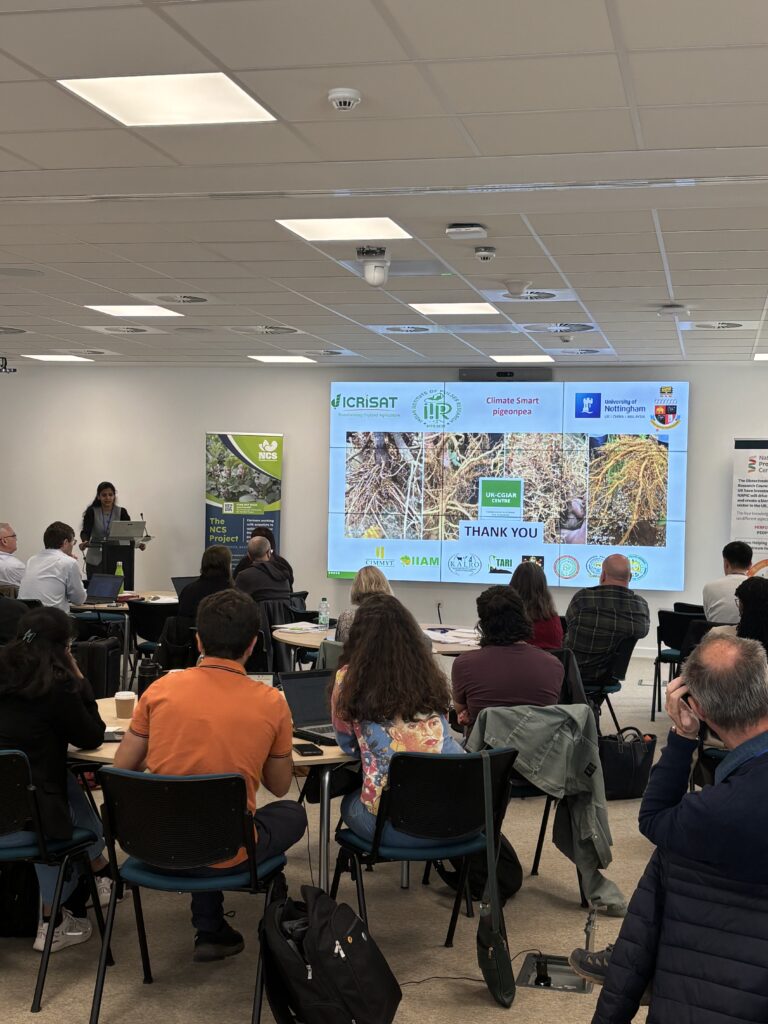
The University of Nottingham’s Aneesh Lale and Ashwini Kalyan presented on the work of the UK-CGIAR Centre project on heat stress in pigeon pea crops. Pigeon pea is a widely grown grain legume, especially in parts of Asia and sub-Saharan Africa. The crop’s drought tolerance, nutritional qualities, and soil improvement potential make it a promising crop for sustainable agriculture in many climate-challenged regions. However, its production is vulnerable to high temperature events, which are becoming more frequent due to climate change.
The researchers on the project are studying how temperature affects root growth directly in soil, using the latest scanning technology at the Hounsfield Facility at the University of Nottingham. Preliminary laboratory results indicate that pigeon pea shows significant plasticity in root traits when responding to heat and drought stress. This plasticity could be harnessed as an important trait for abiotic stress resilience. Root screening of a large subset of the pigeon pea germplasm under heat stress is currently underway in the University of Nottingham which will reveal the genetic diversity in pigeon pea for favourable root traits. These studies are being complemented by field research led by international partners who are examining changes in root architecture and anatomy, rhizosphere signalling and their interplay in microbial recruitment, nodule formation, nitrogen fixation, and overall plant performance.
The research consortium builds upon a strong history of collaboration between the University of Nottingham, CGIAR and local partners, The local partners inlude Kenya Agricultural and Livestock Research Organization (KALRO) Tanzania Agricultural Research Institute (TARI) Chitedze Agricultural Research Station, Department of Agricultural Research (CARS), Indian Institute of pulses research (IIPR), Professor Jayashankar Telangana State Agricultural University (PJTSU), and University of Agricultural Sciences (UAS).
Overall, the event showcased how UK-based legume research is playing an important role in improving crop resilience, boosting biological nitrogen fixation, and improving nutritional qualities. Leading UK institutions, including those working on UK-CGIAR projects, are driving this work through genetic research, field trials, and collaborations designed to shift agriculture toward more sustainable, climate-smart systems. In the long term, the outcomes of this research could have huge socio-economic and nutritional benefits for both the UK and the rest of the world. With legumes still underutilised in the UK, events such as UKLRC play a key role in stimulating much needed dialogue between scientists and fostering innovation for more sustainable legume-based systems.
Main image credit: Luiano Antonio.